






How to harness AI’s real value in food compliance without introducing risk
Artificial intelligence is gaining traction across the food and beverage industry, as companies look for ways to streamline operations and reduce costs in an increasingly complex global environment.
Rising tariffs, ingredient costs, energy prices, and regulatory pressures are forcing organizations to find new efficiencies. As AI tools—particularly Large Language Models (LLMs)—become more accessible, some businesses are now asking a critical question: Can AI replace traditional nutrition calculation and labeling systems?
The short answer: not safely on its own.
AI can create real value in food compliance, labeling, supplier management, and product development, but only when it is connected to trusted data, regulatory logic, audit trails, and governed workflows. Without this, it can introduce significant risk.
Can AI be used for food compliance?
Yes, but only if it is built on trusted data, regulatory rules, and controlled workflows.
Today, AI can add real value to food compliance workflows by:
- Automating data extraction
- Accelerating documentation processes
- Reducing manual effort
However, nutrition labeling is a regulated, high-risk function. Outputs must be:
- Accurate
- Traceable
- Reproducible
- Fully compliant with regional regulations
General-purpose AI tools are not designed to meet these requirements on their own.
“In food labeling, looking correct is not enough—outputs must be provably accurate, fully traceable, and compliant with regulation.”
— Jill Hohnstein, TraceGains Nutrition & Labeling Manager
Why general AI tools fall short in food labeling compliance
AI generates responses based on patterns, not verified regulatory logic.
This creates a critical gap:
- AI outputs are plausible
- Compliance outputs must be provable
A compliant food label must:
- Stand up to audit scrutiny
- Be reproducible across systems
- Align with country-specific legislation
AI alone cannot guarantee this, especially when:
- Data sources are unverified
- Inputs are incomplete
- Regulatory rules are complex and evolving
What are the most common AI food labeling errors?
AI-generated labels often look polished but fail on critical compliance details.
Common risks include:
- Use of unvalidated datasets (e.g. missing USDA or CoFID alignment)
- Misinterpretation of regional regulations (FDA, CFIA, UK / EU etc.)
- Lack of audit trail or traceability
- Inconsistent, non-repeatable outputs
- “Hallucinated” values presented with confidence
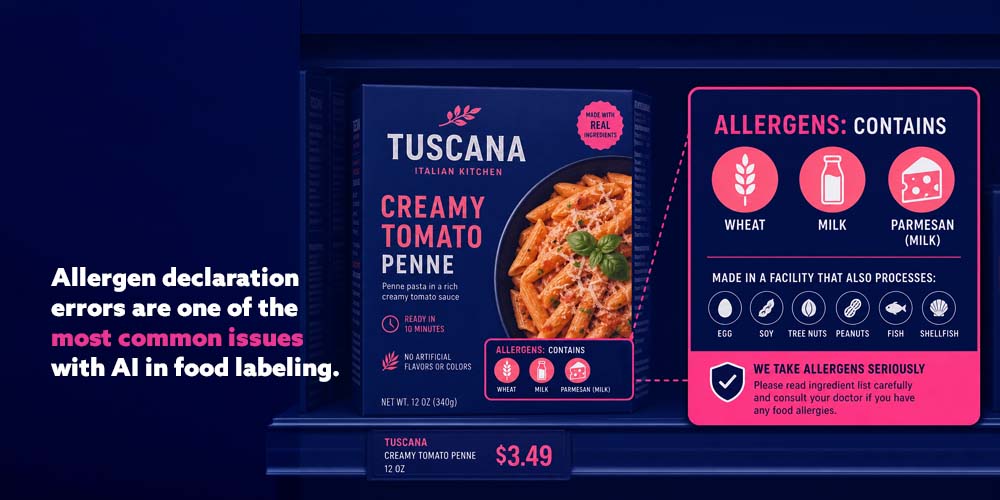
- Allergen declaration errors
TraceGains’ own analysis of AI-generated labels has identified:
- Incorrect formatting and layout
- Missing mandatory elements (e.g. household measures)
- Incorrect rounding rules (e.g. Health Canada requirements)
- “Almost correct” nutrient values that fail compliance thresholds
In regulated environments, “almost correct” is still non-compliant.
Why labeling errors create serious business risk
Labeling errors are one of the leading causes of food recalls globally.
- 45.8% of FDA recalls in 2025 were linked to allergen mislabeling
- Undeclared allergens can cause severe or fatal reactions
- Errors trigger recalls, fines, and supply chain disruption
Beyond compliance, the business impact includes:
- Lost retailer trust
- Brand damage
- Wasted inventory and rework costs
- Reduced profitability
“A label that is almost correct is still non-compliant—and in food safety, that margin of error can have serious consequences.”
— Jill Hohnstein, TraceGains Nutrition & Labeling Manager
What is “shadow AI” and why does it matter?
Shadow AI refers to the unapproved use of AI tools within an organization.
Even if a company has no formal AI strategy, employees are likely already using tools like ChatGPT in daily workflows.
This creates hidden risks:
- Sensitive data (e.g. recipes) entered into external systems
- No governance or oversight
- Inconsistent processes across teams
In compliance-heavy environments, this lack of control can lead to data security and regulatory exposure.
Are recipes and formulations at risk with general AI tools?
Yes, recipes are high-value intellectual property.
When entered into general AI tools:
- Data may leave controlled environments
- Storage and reuse policies may be unclear
- Organizations lose visibility over how information is handled
This introduces risks related to:
- IP protection
- Data governance
- Regulatory compliance
Why integration and data infrastructure matter
Food labeling does not exist in isolation.
It is part of a broader ecosystem including:
- Product lifecycle management (PLM)
- Supplier data systems
- Regulatory workflows
Most AI tools operate outside these systems, leading to:
- Manual data transfer
- Duplication and inconsistency
- Breakdown of a “single source of truth”
At scale, this results in:
- Fragmented workflows
- Poor traceability
- Increased compliance risk
What is missing from most AI approaches?
The key gap is data infrastructure and governance.
AI outputs are only as reliable as the data behind them. Many approaches lack:
- Trusted, validated datasets
- Versioned data architecture audit trails
- Regulatory logic frameworks
- Governed workflows
Instead, AI may rely on:
- Unstructured web data
- Inferred or incomplete information
This produces outputs that look credible, but are not defensible.
A better approach: AI with guardrails
AI should not be used as a standalone decision-maker in food compliance.
Instead, it must operate within:
- Validated data systems
- Regulatory frameworks
- Controlled workflows
This is the principle behind “AI with guardrails.”
How TraceGains applies AI safely
TraceGains embeds AI within a structured compliance ecosystem.
Key principles include:
- AI operating with industry-specific, validated data
- Data extraction, mapping, and contextual understanding—not unverified generation
- Human-in-the-loop validation
- Continuous testing and accuracy checks
- Full auditability and traceability
This ensures AI enhances efficiency without compromising compliance.
The role of NutriCalc in accurate labeling
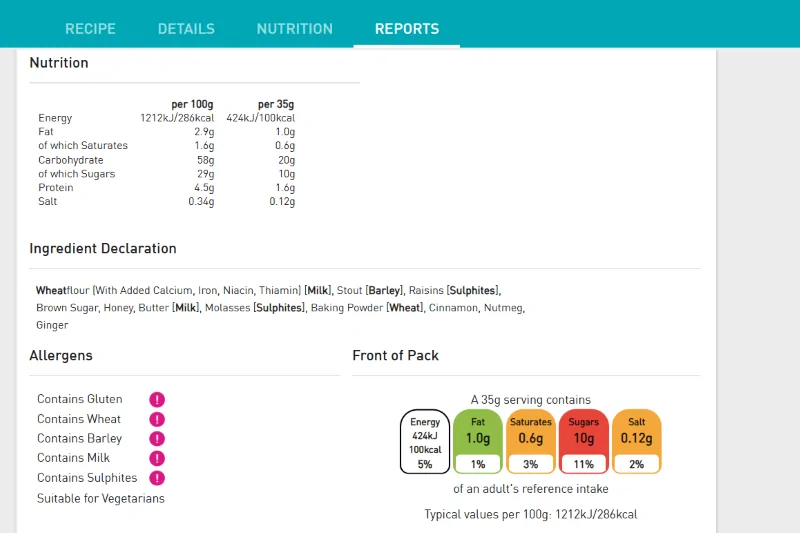
TraceGains’ NutriCalc engine provides:
- Deterministic nutrition calculations
- Regulatory-aligned outputs
- Continuously updated compliance logic
Built on decades of food science expertise, it delivers:
- Proven accuracy
- Repeatability
- Audit-ready outputs
This is fundamentally different from AI-generated approximation.
Where AI is adding real value today
AI is most effective today when applied to structured, lower-risk tasks, such as:
- Extracting data from Certificates of Analysis (COAs)
- Automating document processing
- Reducing manual data entry
This improves:
- Speed
- Accuracy
- Operational efficiency
—while keeping compliance controls intact.
From AI innovation to AI sprawl
As AI tools become easier to deploy, organizations risk creating “AI sprawl.”
This happens when:
- Multiple tools operate without integration
- Outputs are not validated
- Systems lack governance
“As AI makes it easy to spin up credible-looking apps, the challenge shifts from creation to coherence. Without structured data, governance, and integration, organizations risk app sprawl with outputs that aren’t validated or aligned. The real value comes from deploying AI within a single connected, controlled ecosystem that ensures accuracy, consistency, and long-term intelligence.”
— John Thorpe, TraceGains Senior Director, Product Management – Innovation
The real value of AI comes from:
- Integration
- Consistency
- Controlled deployment
—not isolated apps.
The bottom line: Can AI replace compliance systems?
No. AI is an accelerator, not a replacement.
When used correctly, AI can:
- Improve efficiency
- Reduce manual work
- Enhance workflows
But without proper controls, it introduces:
- Compliance risk
- Data security concerns
- Business disruption
Key takeaways
- AI can create real value in food compliance but not replace validated systems
- “Plausible” outputs are not the same as compliant outputs
- Labeling errors carry serious safety and financial risks
- Data governance and integration are essential
- AI must operate within structured, controlled environments
AI in food labeling: Why governance matters more than ever
AI is transforming productivity but without governance and integration, those gains don’t scale.
The real value lies in embedding AI within structured, validated systems that ensure:
- Accuracy
- Consistency
- Compliance
TraceGains enables this through an AI-with-guardrails approach, helping organizations bring products to market safely, efficiently, and with confidence.
Explore how TraceGains NutriCalc helps teams streamline nutrition analysis and labeling workflows while maintaining the accuracy and compliance modern food innovation demands.