






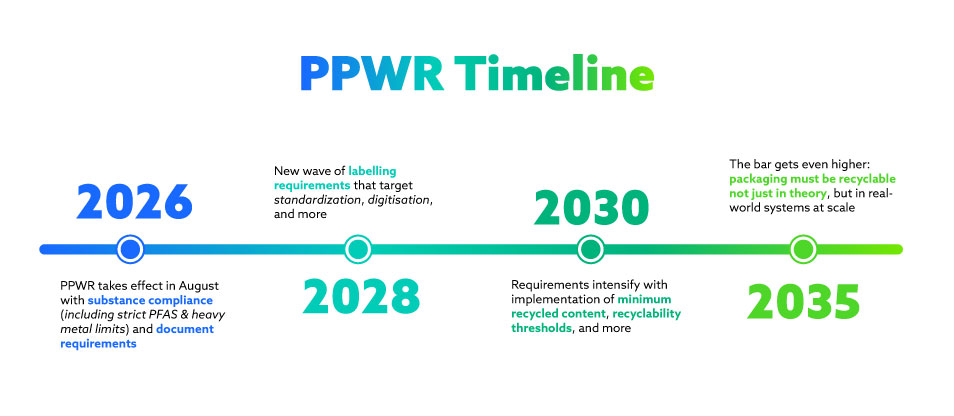
August 12, 2026 isn’t just another regulatory milestone. It is a hard stop. Under the EU’s Packaging and Packaging Waste Regulation (PPWR), all packaging placed on the market must meet strict requirements from day one. No grace period. No partial compliance. If your packaging doesn’t meet EU PPWR compliance standards, it doesn’t go to market. Full stop.
Most conversations around PPWR focus on packaging redesign: new materials, lighter formats, recyclable structures. That work matters, but it’s not the real bottleneck.
The real challenge is this: can you prove your packaging is compliant at the SKU level, across every market, backed by verifiable data?
Because PPWR isn’t just regulating what your packaging is made of. It’s regulating your ability to collect, connect, and validate data across your entire supply chain.
To get there, CPG and food & beverage companies need to focus on four pillars:
- Structured packaging data
- Verified supplier traceability
- Connected digital labeling systems
- Collaborative product and packaging development that enables faster reformulation when packaging requirements change
What are the key requirements for EU PPWR compliance?
1. Packaging data: The foundation you can’t see (but regulators will)
You can’t comply with what you can’t see. And for most organizations, packaging visibility stops well short of what PPWR requires.
By August 2026, every packaging format must be backed by:
- Substance compliance (including strict PFAS and heavy metal limits)
- A complete EU Declaration of Conformity (DoC)
- Supporting technical documentation (composition, recyclability, safety)
That’s not a packaging problem. That’s a data problem at scale.
The reality is that packaging data is rarely centralized. It’s scattered across supplier documents, buried in PDFs, locked in spreadsheets, or split between PLMs, ERPs, and inboxes. Try stitching that together at the SKU level across hundreds, or thousands, of products, and things break fast.
What PPWR demands is a structured, connected view:
materials → packaging components → finished goods → compliance outputs
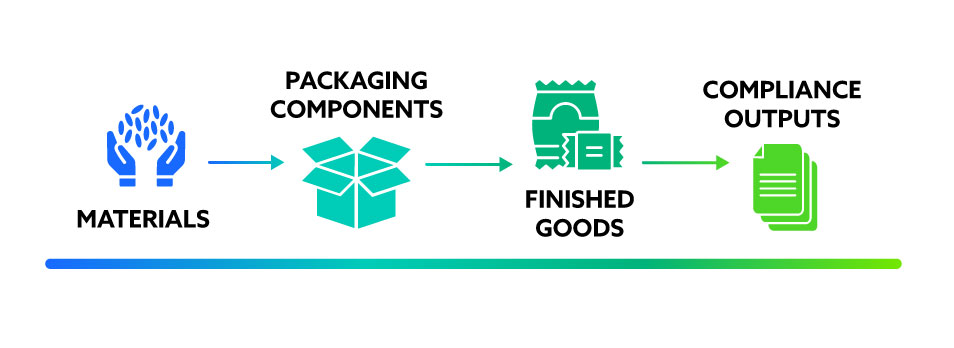
In other words, a packaging data model that actually reflects how your products are built.
This is where leading teams are shifting their approach, moving from document collection to data orchestration. Packaging Specification Management from TraceGains helps transform fragmented specifications into a connected system, creating a digital thread that links every material to the finished product it impacts. The result is seamless compliance that’s built into how your data works.
2. Supplier traceability: From chasing documents to verifying data
PPWR doesn’t just raise the bar internally; it pushes accountability upstream.
You’ll be required to:
- Identify manufacturers and importers directly on packaging
- Maintain supplier declarations for materials and substances
- Verify that upstream data is accurate, current, and complete
That last point is where things get uncomfortable.
Because most companies aren’t managing supplier data; they’re chasing it. Emails, attachments, outdated certificates, version confusion. And when regulations tighten, that model collapses under its own weight.
Under PPWR, incomplete or unverifiable supplier data isn’t an inconvenience. It’s a compliance risk that can block market access.
Traceability, then, means trusting your data, not just tracking shipments.
That requires a shift from static documents to dynamic, structured information. With automated supplier data collection and AI-powered document intelligence, companies can extract critical details—composition, compliance declarations, material attributes—from unstructured files and turn them into usable data.
Instead of periodic scrambles to gather documentation, you get a continuously updated, audit-ready view of your supplier network.
And when the deadline hits, that difference shows up fast.
3. Digital labeling: Where data meets the consumer
If 2026 is about proving compliance, 2028 and beyond are about communicating it clearly and consistently.
PPWR introduces a new wave of labeling requirements:
- Harmonized EU labeling (material identification, sorting instructions)
- Standardization across markets (no more country-by-country variations)
- Digital labeling via QR codes and data carriers for reuse systems
On the surface, this looks like an artwork redesign challenge. In reality, it’s a data synchronization challenge.
Because every label is only as accurate as the data behind it.
If your packaging specs, material data, and compliance attributes aren’t aligned, your labels won’t be either. And when you’re managing hundreds of SKUs across multiple regions, even small inconsistencies can cascade into costly errors.
This is where disconnected workflows become a liability. Packaging data lives in one system, artwork in another, approvals somewhere else entirely. Version control gets messy. Timelines slip. Risk increases.
The alternative is a connected approach, where packaging specifications and artwork management are tightly integrated. With solutions like TraceGains and WebCenter Go, teams can ensure that the data driving labels is always current, approvals are controlled, and every update is traceable.
Because under PPWR, labeling encompasses more than design; it requires data accuracy at scale.
4. Packaging changes will drive product changes, too
For many food and beverage manufacturers, PPWR won’t end with a new package. It will require a new product.
As companies transition to more recyclable mono-materials, increase post-consumer recycled (PCR) content, or move away from certain foil-backed and multi-layer packaging structures, they’ll encounter an unavoidable reality: not all packaging performs the same.
Barrier properties that protect products from oxygen, moisture, light, or contamination can change significantly depending on the substrate. That can affect everything from shelf life and product freshness to texture, flavor, and food safety.
In other words, a packaging decision quickly becomes an R&D challenge.
That means formulation teams will increasingly be asked questions they may not have anticipated:
- Can this recipe maintain its shelf life in a different packaging format?
- Will preservatives, moisture levels, or ingredient ratios need to change?
- How can product quality be maintained while meeting new sustainability requirements?
- Can reformulation and packaging redesign happen in parallel instead of sequentially?
Organizations that continue treating packaging development and product formulation as separate workstreams risk creating costly delays, duplicate testing, and extended commercialization timelines.
A more connected approach allows R&D, packaging, regulatory, and quality teams to evaluate packaging and product changes together. With integrated formulation and packaging specification management, manufacturers can assess the downstream impact of packaging decisions earlier in the development process, reducing costly iterations while accelerating compliant product launches.
As PPWR pushes the industry toward more sustainable packaging, the companies that respond fastest won’t simply redesign their packaging; they’ll synchronize packaging innovation with product innovation.
Beyond 2026: The real work begins
It’s tempting to treat August 12, 2026 as the finish line. It’s not. It’s the entry point.
By 2030, the requirements intensify:
- Only packaging meeting recyclability thresholds (A–C) can remain on the market
- Minimum recycled content becomes mandatory
- Reuse and refill targets scale, especially for beverage and transport packaging
- Certain single-use formats are eliminated entirely
And by 2035 and beyond, the bar gets even higher: packaging must be recyclable not just in theory, but in real-world systems at scale.
This isn’t a one-time compliance effort. It’s a continuous transformation of how packaging is designed, sourced, and validated.
Which means your systems need to evolve, too.
Companies that succeed won’t be the ones making isolated changes. They’ll be the ones building connected ecosystems where packaging, formulation, supplier data, and compliance workflows operate as a single, intelligent system.
That’s how you move from reacting to regulations to staying ahead of them.
What does it take to prepare for EU PPWR compliance?
Preparing for EU PPWR compliance comes down to four core capabilities:
- Structured packaging data
- Verified supplier traceability
- Connected digital labeling systems
- Collaborative product and packaging development
Get those right, and PPWR becomes a lot more manageable, and a lot more valuable.
Companies that can centralize packaging information at the SKU level, validate supplier data with confidence, and ensure labeling accuracy across markets won’t just meet requirements; they’ll be positioned to adapt as regulations evolve.
Want to see what that looks like in practice?
Explore how the TraceGains NPD suite—with integrated packaging specification management and WebCenter Go artwork workflows—helps CPG and food & beverage brands build connected packaging data systems to prepare for PPWR, and everything that comes next.