







In food and beverage, packaging isn’t a single spec. It’s a chain.
Raw materials feed components. Components build packaging structures. Structures roll up into SKUs. SKUs connect to finished goods. Finished goods go to shelf.
Yet in many organizations, those F&B packaging levels are managed as separate records—often in separate systems—with little intelligence connecting them.
That’s where complexity creeps in. And where misalignment begins.
The hidden risk in fragmented packaging spec levels
At first glance, managing packaging specs at different levels seems straightforward:
- A resin or substrate spec
- A bottle or carton component spec
- A case or pallet configuration
- A SKU-level packaging definition

But when those F&B packaging levels aren’t formally linked, teams end up relying on manual interpretation to understand how everything fits together.

That leads to:
- Redundant spec creation across SKUs
- Missed impact analysis when materials change
- Inconsistent data between packaging levels
- Slower updates when suppliers adjust inputs
- Downstream confusion about which version governs which product
A change to a raw material shouldn’t require detective work to understand which SKUs are affected. Yet in disconnected systems, that’s often exactly what happens.
The problem isn’t the number of packaging levels.
It’s the lack of structured relationships between them.
From materials to structure to SKU
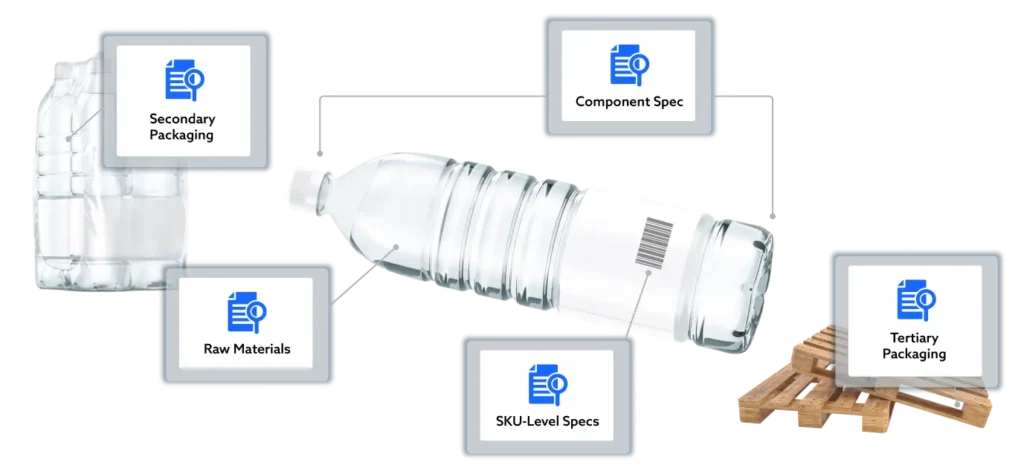
Think about a simple beverage bottle:
- The raw material spec defines resin composition and compliance data.
- The component spec defines the bottle format, dimensions, and performance requirements.
- The secondary packaging spec defines case configuration and corrugate.
- The tertiary packaging spec defines pallet pattern and logistics attributes.
- The SKU-level spec brings it all together under a finished good.
When those F&B packaging levels live independently, every update becomes manual alignment work.
But when they’re connected through defined relationships, the system understands the chain automatically.
That’s the shift PackMan introduces.
How PackMan connects the packaging chain
PackMan doesn’t just store packaging specs. It models how they relate.
Through structured assemblies and linked components, Packaging Specification Management creates defined connections between:
- Raw material specifications
- Primary, secondary, and tertiary packaging levels
- Packaging assemblies
- SKU-level finished goods
These aren’t loose references. They’re governed relationships.
That means:
- A component can be reused across multiple SKUs without duplicating specs.
- Updates to a raw material can trigger controlled review of affected packaging structures.
- Version control ensures everyone is working from the correct iteration.
- Rules prevent invalid combinations from being published.
Instead of guessing how packaging levels connect, the system defines it.
Instead of manually reconciling spreadsheets, teams see impact in context.
Relationships replace rework
The real power of connecting F&B packaging levels is what it prevents.
Without structured relationships:
- Teams recreate specs unnecessarily.
- Data drifts across versions.
- Packaging updates require broad email threads to validate downstream impact.
- Launch timelines expand because validation takes longer than creation.
With PackMan:
- Packaging levels are intentionally linked.
- Version control governs changes.
- Reuse becomes controlled, not chaotic.
- Impact analysis becomes visible, not manual.
It transforms packaging management from document storage into a governed lifecycle.
And that lifecycle connects directly to finished goods.
SKU-level clarity without the complexity
At the SKU level, everything converges.
Formula.
Packaging levels.
Components.
Artwork.
If any upstream element changes, SKU integrity depends on teams catching and reconciling that change.
When F&B packaging levels are fractured, SKU-level specs become fragile, requiring manual checks and institutional knowledge to validate.
PackMan stabilizes that layer by ensuring SKU definitions are built from structured, version-controlled components. The finished good isn’t a disconnected record. It’s a governed assembly of linked specifications.
That clarity reduces launch risk and increases confidence across teams.
Why this matters for speed and scale
As portfolios expand and supplier networks evolve, packaging complexity increases.
New materials.
Sustainability initiatives.
Retailer requirements.
Global sourcing shifts.
If F&B packaging levels aren’t connected structurally, every additional SKU multiplies the operational burden.
PackMan scales differently.
Because relationships are defined once and reused intelligently, complexity doesn’t spiral with growth. It stays governed.
The result?
- Faster SKU creation
- More controlled updates
- Reduced duplication
- Stronger cross-functional alignment
And most importantly, fewer surprises when products move toward launch.
What comes next: artwork in context
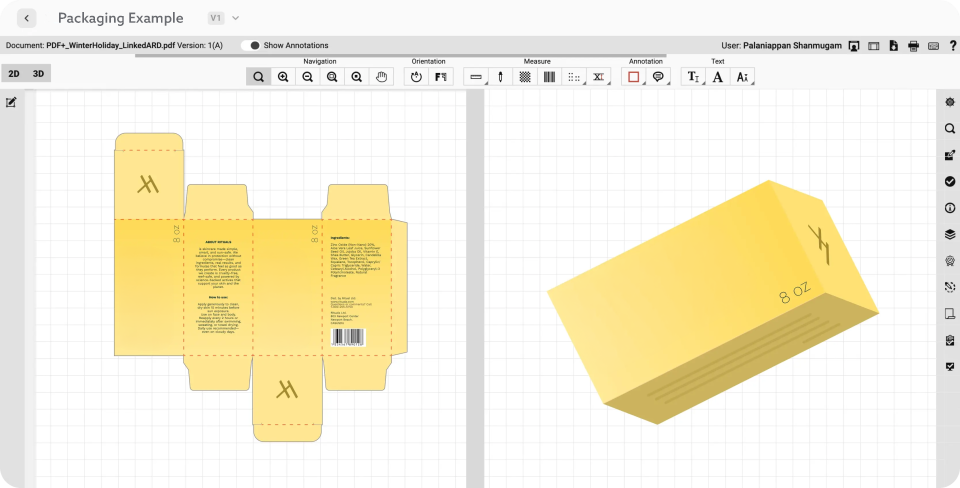
Connecting raw materials to packaging structures and SKU-level specs solves a major piece of the puzzle.
But there’s another layer that often lives outside this chain: artwork.
Labels and graphics are tied to packaging components, but too often managed separately from the packaging specifications themselves.
In our next blog in the PackMan series, we’ll explore how PackMan bridges that final gap through its relationship with Esko’s WebCenter Go, bringing packaging specs and artwork approvals into sync within one connected lifecycle.
Because packaging isn’t complete until artwork aligns.
Explore Packaging Specification Management
Ready to see how PackMan connects raw materials, packaging structures, and SKU-level definitions into one governed lifecycle?
Learn more about Packaging Specification Management.