The “healthy consumer” isn’t a future trend. It’s already reshaping purchasing behavior faster than brands can react.
What used to be a straightforward equation—balance nutrients, meet labeling requirements, go to market—has become far more complex. Today, brands must navigate shifting expectations around ultra-processed foods, evolving dietary guidance, and increasingly strict global regulations, all while maintaining taste, cost, and speed to market.
At the center of this shift is a new reality: winning the healthy consumer in food & beverage requires connected data.
A fragmented definition of “healthy”
There’s no single definition of “healthy” anymore.
In the U.S., updated dietary guidance is placing greater emphasis on limiting added sugars and scrutinizing levels of processing. At the same time, state-level actions from additive bans to legal pressure around ultra-processed foods are accelerating change ahead of federal clarity.
In the UK, HFSS (High Fat, Sugar, Salt) regulations are already reshaping how products are formulated, marketed, and even placed in stores.
Layer in rising consumer skepticism around ingredients and processing, and the result is a fragmented, fast-moving target.
For food and beverage brands, this creates a fundamental challenge: How do you build products that meet multiple, evolving definitions of “healthy” at once?
The hidden problem: disconnected data
Most organizations aren’t struggling because they lack data. They’re struggling because their data is disconnected.
- R&D teams are reformulating products based on evolving nutritional targets
- Regulatory teams are interpreting shifting policies across markets
- Procurement is sourcing alternative ingredients
- Packaging teams are updating labels and claims
But too often, these functions operate in silos.
What follows is a fragmented process that slows innovation, increases risk, and makes it harder to keep pace with evolving health expectations:
- Reformulations that don’t align with labeling requirements
- Ingredients that meet cost targets but introduce regulatory risk
- Claims that don’t fully reflect what’s in the product
- Delays caused by manual rework and misalignment
In a world where definitions of “healthy” are constantly evolving, disconnected data isn’t just inefficient; it’s a liability.
Why is connected data important for F&B?
Connected data brings together formulation, sourcing, nutrition, and labeling into a single, unified ecosystem.
This allows brands to:
1. Reformulate with confidence
Teams can evaluate ingredient changes in real time; understanding not just cost and functionality, but nutritional impact and regulatory implications across markets.
2. Design for multiple regulatory outcomes
Instead of reacting to each new policy shift, brands can proactively model how products perform under different frameworks, whether that’s U.S. dietary guidance, state-level restrictions, or UK HFSS thresholds.
3. Align claims with reality
With connected ingredient and nutrition data, brands can ensure that what’s on the label accurately reflects what’s in the product; reducing risk and building trust.
4. Move faster without breaking things
When data flows across teams, decisions that once took weeks—reformulation, validation, label updates—can happen in days.
From compliance to competitive advantage
Historically, many of these processes were driven by compliance: meet the standard, pass the audit, move on.
That’s no longer enough.
Today, health is a competitive battleground. The brands that win will be those that can:
- Adapt formulations quickly as definitions evolve
- Deliver on clean label expectations without sacrificing taste or convenience
- Communicate clearly and consistently across every touchpoint
- Scale innovation across markets with different regulatory requirements
None of that is possible without connected data.
The role of a connected ecosystem
This is where a connected ecosystem becomes critical.
Addressing the healthy consumer isn’t a single function, but rather a cross-functional challenge that spans sourcing, formulation, nutrition, and packaging. When these elements operate in silos, brands are left reacting to change. When they’re connected, brands can get ahead of it.
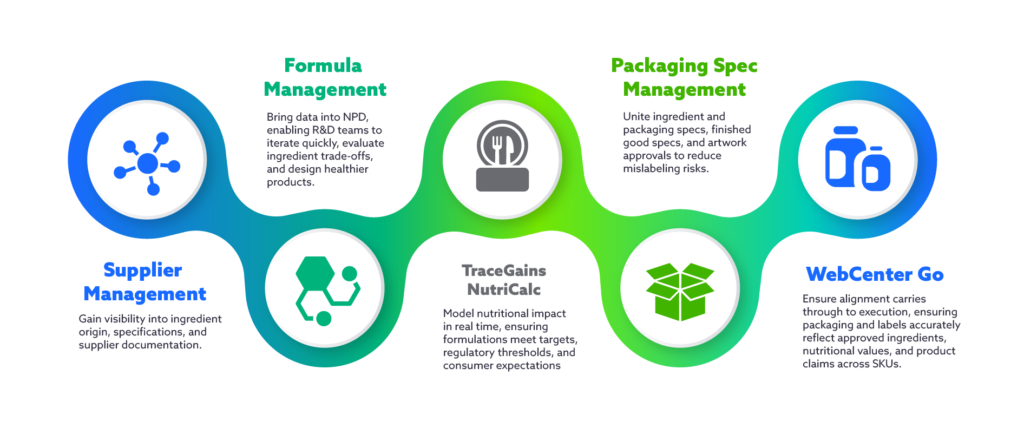
With TraceGains Supplier Management, teams gain visibility into ingredient origin, specifications, and supplier documentation, making it easier to source cleaner ingredients and validate claims with confidence.
Formula Management then brings that data into the product development process, enabling R&D teams to iterate quickly, evaluate ingredient trade-offs, and design products that align with evolving definitions of “healthy.”
Paired with NutriCalc, brands can model nutritional impact in real time, ensuring formulations meet internal targets, regulatory thresholds, and consumer expectations before they ever reach the market.
And with Packaging Specification Management and artwork integration through WebCenter Go, that alignment carries through to execution, ensuring packaging and labels accurately reflect approved ingredients, nutritional values, and product claims across every SKU and market.
Together, this connected ecosystem creates a single source of truth linking every decision from supplier to shelf.
The future of healthy product development
The healthy consumer isn’t waiting for definitions to stabilize, or for brands to catch up.
As dietary guidance evolves, ultra-processed foods come under greater scrutiny, and regulations like HFSS reshape the global landscape, food and beverage companies are being asked to do more than ever before.
They’re being asked to connect sourcing with formulation.
To align nutrition with labeling.
To ensure that what’s promised on the package reflects what’s inside.
Because in today’s environment, brands must do more than create healthier products. They need to prove it consistently and transparently at every stage of the product lifecycle.
And that only happens with connected data.
Ready to connect your data and deliver for the healthy consumer?
Discover how the TraceGains connected ecosystem helps you innovate faster, reduce risk, and bring compliant, consumer-ready products to market with confidence.