






A CMO perspective on why our AI story outpaces the market
There’s a lot of AI messaging in the market right now. Most of it sounds the same. Everyone claims automation. Everyone claims intelligence. Everyone claims speed. In food and beverage, packaging, compliance, and supplier collaboration, AI has become the easiest word to say and the hardest one to prove.
From a CMO perspective, that creates both a challenge and an opportunity. The challenge is obvious: buyers are flooded with broad, interchangeable claims. The opportunity is that the companies with a genuinely stronger AI story can finally separate themselves, not by shouting louder, but by showing what their infrastructure actually makes possible.
That is where our story is different.
The real AI question is not “Do you have AI?”
It is: what is your AI built on?
In our space, AI only becomes valuable when it can work inside the operational realities brands deal with every day, supplier documentation, ingredient and specification data, regulatory requirements, packaging specifications, label content, artwork workflows, and the decisions that connect them from source to shelf.
Generic AI can summarize. It can draft. It can classify. But that is not enough.
What brands actually need is AI that understands the structure, variability, and risk of food and beverage data. AI that helps teams reduce manual work, surface risk earlier, and move faster without creating new errors downstream.
TraceGains publicly positions its AI around food-and-beverage-specific intelligence, including continuous monitoring of supplier data, early identification of compliance gaps, and reducing delays and last-minute scrambles. That is a fundamentally different proposition than simply layering AI onto a workflow.
Better AI starts with better data, and better data starts with the ecosystem
This is where many AI stories break down. They are built as overlays on fragmented systems. They sit on top of disconnected files, isolated tasks, and incomplete records. They may help with one step, but they do not improve continuity across the full process. The business gets pockets of automation without gaining a real operating advantage.
Our advantage comes from the fact that AI is not being bolted onto disconnected point solutions. It is being built into an ecosystem already designed to connect supplier management, ingredient and spec data, compliance workflows, product development, packaging specifications, and artwork execution. TraceGains describes its platform as modular but connected, with all solutions drawing from TraceGains Gather® network’s supplier and ingredient data foundation.
That matters because AI is only as strong as the environment it operates in. If the underlying data is fragmented, stale, or manually recreated across teams, AI can only accelerate confusion. If the underlying data is connected, structured, and continuously enriched through the network, AI can improve decision-making across the business.
Why our AI story is stronger than the market’s
The market is full of AI claims. But most providers are still solving in pieces. One tool focuses on document extraction. Another on workflow automation. Another on packaging. Another on regulatory content. Another on analytics. That may create isolated wins, but it does not create a unified operating model.
Our AI story is stronger because it sits on top of a broader infrastructure advantage: industry-specific data, network scale, operational context, and cross-workflow continuity.
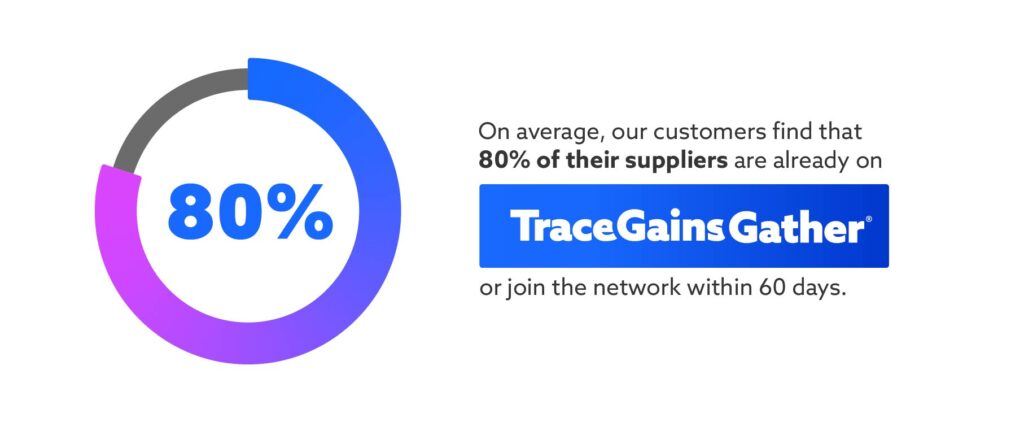
TraceGains has built up the Gather network that connects more than 100,000 supplier locations globally and, on average, 80% of suppliers are already on Gather or join within 60 days. Those are not just scale metrics. They are AI-enabling metrics, because they reflect the density, relevance, and continuous refresh of the data layer underneath the workflows.
That is difficult to imitate. It means our AI does not have to start from scratch. It works inside a living ecosystem that is already growing, already structured around food and beverage workflows, and already designed to connect upstream and downstream decisions. That gives participants advantages that disconnected architectures simply cannot match.
AI is most powerful when it reduces rework across the whole process
Too much AI messaging is framed around narrow productivity, faster reviews, faster summaries, faster task completion. That matters, but it misses the bigger value. In our market, the most meaningful AI outcome is not just faster work. It is less rework.
Less chasing supplier documents. Less manual rekeying of specifications. Less duplication across regulatory, quality, packaging, and commercialization teams. Less late-stage artwork correction because upstream data changed and no one saw it in time.
TraceGains’ Document Intelligence and AI-driven compliance messaging increasingly point in exactly that direction: turning unstructured supplier and quality documentation into usable structured data, catching issues earlier, and enabling faster, more confident decisions. That matters because the real cost in this industry is not just slow work. It is correction work.
The packaging layer makes the story even stronger
In most organizations, the disconnect between product data and packaging execution is still one of the biggest sources of risk. Specifications live in one place. Artwork workflows live in another. Approval status lives in email. Packaging claims get reviewed too late. Teams spend time reconciling what should already be aligned.
That is why the combination of TraceGains Packaging Specification Management and integration with Esko WebCenter Go is so strategically important. TraceGains says packaging specs, components, assemblies, and artwork workflows can now be connected so packaging stays in sync with product changes. It also states that finished-goods specifications can be linked directly to artwork projects managed in WebCenter Go, giving teams visibility into approval status and helping ensure packaging and labels reflect the latest formulas, claims, and regulatory requirements.
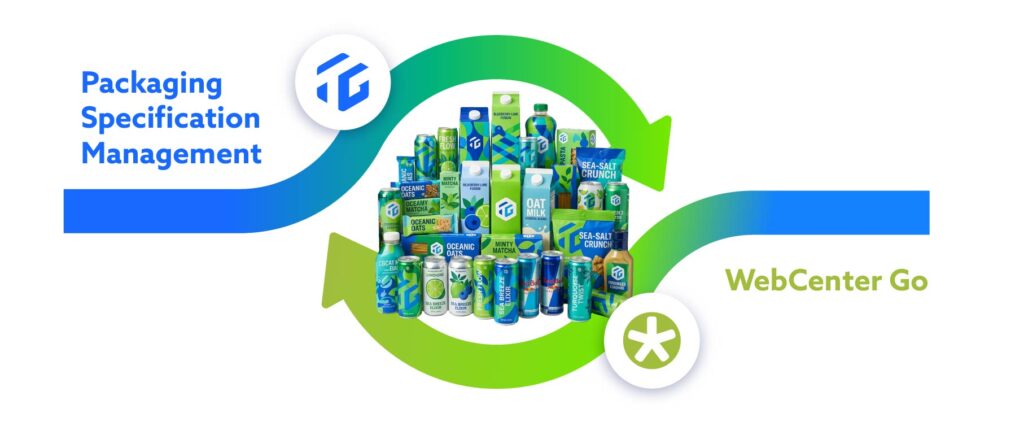
That is more than integration. It is the foundation for a better AI future, because it connects upstream product and supplier intelligence with downstream packaging execution. In practical terms, that means AI can operate with broader context and create value across more of the commercialization chain.
Veralto gives this story even more credibility
This is not a standalone AI story. It is part of a larger Veralto story about safeguarding product quality, reducing risk, and helping customers operate with more confidence in increasingly complex environments. Veralto describes its purpose as safeguarding the world’s most vital resources, and the combination of TraceGains and Esko expands that digital foundation across new product development, compliance, packaging, and commercialization workflows.
That framing matters because the market does not need more AI theater. It needs infrastructure that can support better decisions, better quality outcomes, and faster execution in the real world. That is exactly what this portfolio is being built to do.
The future belongs to AI that understands the work
The strongest AI stories in this space will not come from whoever says the word most often. They will come from companies that can answer the harder questions. Where does the data come from? How fast does it grow? How industry-specific is it? How connected is it across workflows? How much manual recreation does it eliminate? How much rework does it prevent? How well does it carry trusted information from supplier collaboration to compliance to packaging to shelf?
That is where our story outpaces the market. Because our AI is not being layered onto isolated tools. It is being developed inside a connected, food-and-beverage-specific ecosystem with real supplier network scale, real workflow depth, real packaging integration, and a parent company mission grounded in product quality and operational integrity.
The market is full of AI claims. But brands do not win with claims. They win with infrastructure, connected data, and systems that turn intelligence into execution. That’s where we’re different. And that difference is only getting wider.